16 Nov 2014

The Royal Opera House Muscat - Bagpipers, Bugles and Drums!


Royal Opera House Muscat

Bagpipers, Bugles and Drums at ROHM

A few days ago, I read in the papers about a musical show to be held by the Royal Military force of Oman at the Royal Opera House Muscat (ROHM) from 6th to 8th Nov. And I thought that would be so boring!

Military music reminded me of the numerous Hollywood battle movies that showed the military troops marching away in glory, with the bagpipers, bugles and drums, accompanied by some military music in the background.

No ways, I was not going to the Opera House to listen to that! 

But then a thought crossed my mind. Whenever we go to Qurum by the Sultan Qaboos road, we always pass by the ROHM and I always admire its architectural details, but we had never been on the premises whatsoever. So that day curiosity took over and ended my boredom! 

A visit to ROHM had to be made to get a closer look and what day would be better than a Friday when a military music show was being held. This was a free Military Music show planned over a three day period, and it began on Thursday. Luckily for us, we managed to catch it on Friday evening since on the following day, the city received showers and the show was probably canceled.

It was a moonlit night and the Opera House looked stunning with the LED lights. We could see the rays of light emanating from the ROHM building from quite a distance from the road too. The entire building which is white in color was completely transformed into hues of purple and pink due to the LED lights used. A feast for the eyes!

The welcoming entrance by moonlit and LED rays

The open air space for the musical performance

The Musical Band of the Oman Military
Most of the performances were over. However, I heard later that there were ensembles from New Zealand, dancers from Scotland, British singers, traditional Omani dancers for the grand event. We had missed it all. But we were on time to catch the Royal band playing not only the military music but also jazz, opera and pop music. 'The Maidan' (meaning in Arabic - an open ground or space in a marketplace or a parade ground) was assembled with people from all over the city. 
The crowd busy taking videos and snaps
The 'maidan' viewed from the first-floor level
The music played by the band was so catchy that we couldn't stop ourselves from tapping our feet along with it. I was glad we came!


Exploring the ROHM premises - Awed by its Architecture and Interior Design

After the show was over we just walked around to explore the place a little a bit more. The Architectural design of the building, its circulation pattern, the interiors adorned with intricately handcrafted decors, the grand entrance - are all a reflection of the modern Omani Palaces.

         Walking through the colonnades in the Opera House
The Ruler of Oman is a lover of music and the arts. Thanks to the Sultan (for Oman doesn't have the culture of Opera), it was on his order that this beautiful Opera House was built and officially opened in October 2011. This Art complex designed by the Architects WATG (Wimberley Allison Tong and Goo) reflects contemporary Islamic Architecture with its porches, arched colonnades, and terraces. 

The main structure is made of reinforced concrete with block infill and it is finished in locally available desert rose stone and contemporary style stucco. The entire complex is spread over 80,000 sq m of area with nearly 40,000 sq m of area being reserved for gardens. We couldn't access the Grand Auditorium which has a capacity is of 1,100 seats and is of horseshoe shape.

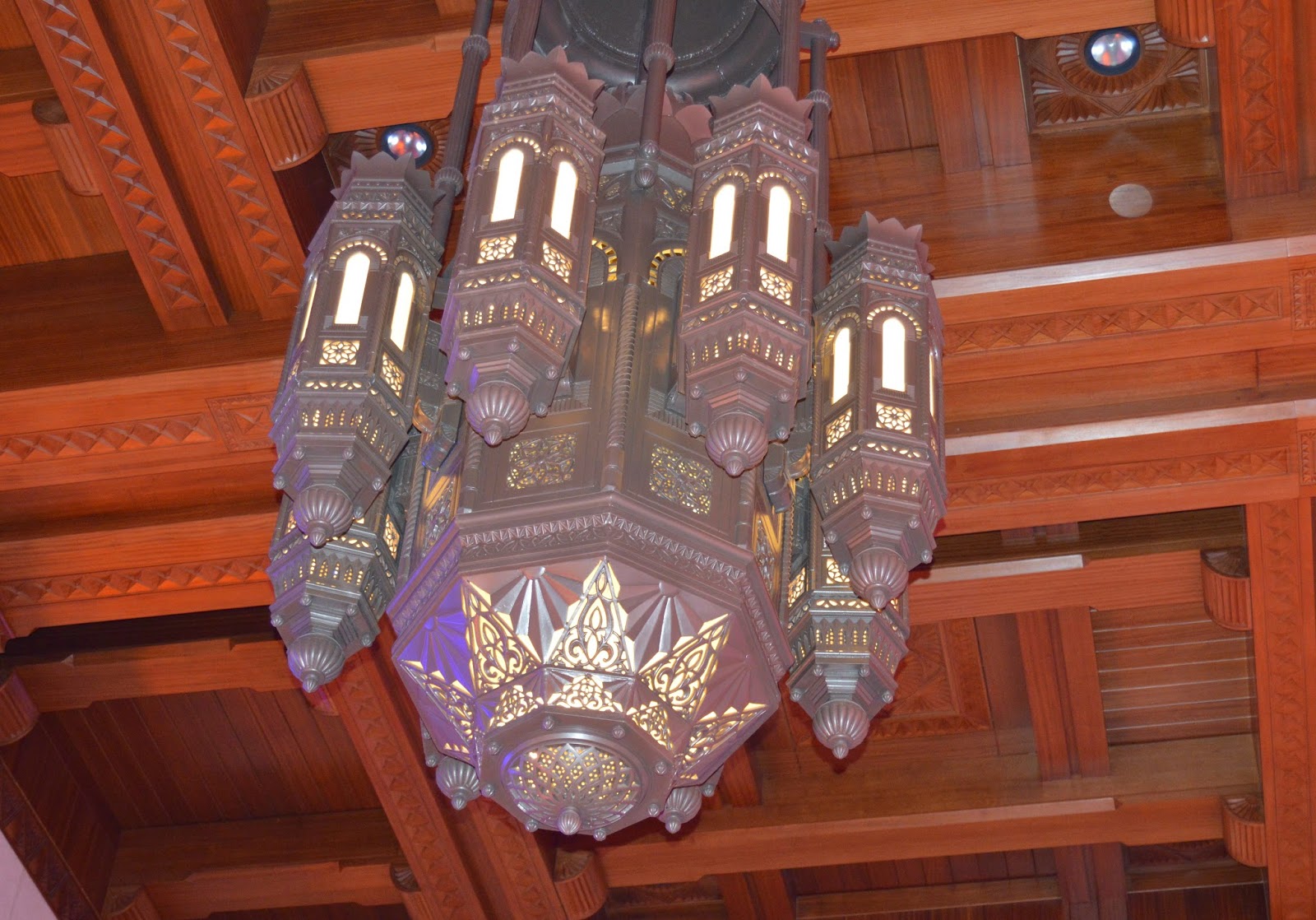
A fusion of Classical Omani and Modern style is reflected in the interiors through the rich crystal chandeliers, hand-carved wooden fixtures, and marble inlays.
East Entrance to the Opera Galleria
The beautiful wooden ceiling 
A closeup view of one of the many Chandeliers
The Opera Galleria is a retail development adjoining the Opera House following the same style and pattern as used in the Opera House. It was officially opened in 2013 and houses a host of multi-cuisine restaurants, luxury souks, retail stores and coffee shops. There are some 50 shops here offering gems, apparels, perfumes, watches and many branded outlets. 

We were glad to spot an Indian restaurant by the name of 'Indus'. A quick look at the restaurant's menu items clearly indicated exotic Indian cuisine while the prices indicated it was aimed at people with money! We took a quick look at the interiors of the restaurant; it did have an impressive look.

Musicians at the main entrance of the Galleria 
The Indus - An Indian Restaurant
The ceiling design in the Galleria
The vaulted colonnade through the mall on level 1
Antique furniture outlet 'Khazir'
An Omani store with its traditional dhows & mabkharas on display
The ceiling design and colorful murals 
in the atrium at the 1st floor level
View of the parking lot - capacity to hold 540 cars
View of the exit road from the Opera Galleria
A parting shot of the Opera Galleria

We missed most of the performances that evening and I hope to catch up next year. But a walk through the ROHM premises that evening, exploring the beautiful building and the grand interiors of the Galleria, certainly made our day. 


sources referred:
www.watg.com
www.rohmuscat.org.om/venue/opera-galleria
Gulfconstructionworldwide.com


6 Nov 2014

Fish, Frankincense and a Friday in Muscat


For the love of Fish:

Anywhere around the world, on a typical weekend, a Bengali household without Fish and Rice cannot be imagined. For all of you who didn't know, Fridays here is like Sundays in other parts of the world, with schools and offices being closed for the day. Fridays are when a mandatory visit is made to the old city area of Muscat by the men of the Bengali household for the purchase of fresh fish which is said to be imported from Bangladesh.

Don't ask me about the price of fish here! It is exorbitantly high for the fresh lot that comes here every Thursday evening. The sellers here justify it by arguing that airborne imported fish would be fresher and hence costlier than the frozen ones that arrive after months by the sea route. And, of course, by the taste of fish, you'll know the difference. Personally, I am not much of a fish lover but my husband and daughter will not have their meals without a fish item.

So for their love for fish, on one Friday morning, I accompanied my husband. As we entered the Muttrah (also spelled as Matrah or Matruh) locality of Muscat we neared the Riyam roundabout and from far away we could view a roundish white Watchtower situated on the hills. At the base of the hills is the popular Riyam park with its colorful rides and beautifully landscaped area. Here I am not going to write about the park. It is the Giant Incense Burner shaped watchtower that inspired me to write this post. I was intrigued by the shape of the watchtower and I sat down with just an A4 sheet and a pencil and sketched it with the hand. But this was before I made this trip to Muttrah.

Sketch of the Watchtower in Riyam park
Continuing on our return trip from the old city, I asked my husband to pull over his car near the Muttrah corniche so that I could click some snaps there and to my delight he agreed. I could capture some beautiful shots of the Watchtower and its surroundings and some views of the Harbour. The corniche area offered ample sitting areas to relax, gaze at the blue sea, the fishing boats and ships that are anchored in the harbor.
Riyam Park with its rides as viewed from the corniche 
Covered sitting area viewing the harbour
The fountains 
View of the harbour
The corniche with the mountains in the backdrop
and numerous benches for sitting
A Portuguese watchtower overlooking the harbour 
The view of the Harbour again:
An image of the old Hamriya region of Muscat on the walls 
The concrete blocks of the retaining wall in the sea
Harbour view - the concrete blocks used as retaining wall

View of the watchtower from the Corniche

In the foreground of the incense burner Watchtower (as you can view in the snap above) on display is a small sculpture made of a pair of dolphins from granite stone. There are some more fish sculptures scattered over the walkway along corniche area. Like the Bengalis, the Omanis also consider fish as a symbol of fertility and reproduction. Apart from agriculture and mining, Fishing is an important economic activity here.  

Zooming in - The Giant incense burner watchtower 
on the hill-top

From Fish to Frankincense:


This Watchtower was built to commemorate Oman's 20th National Day. Since the shape of the Watchtower intrigued me I searched over the net for more information. I found that the Watchtower shape resembled the incense burner, called 'Mabkhara' in Arabic. The Mabkhara (a container made of clay or stone) plays an important role in the homes of Omanis here. A 'Mabkhara' holds frankincense which is a unique aroma of Muscat. Usually, Frankincense is burnt in a Mabkhara on some special occasions like weddings or on Fridays or to just perfume the house. I wanted to know more about the Incense tower, its designer, its height, building materials used and so on, but I could find no information whatsoever.

I have heard about Frankincense in my school where we were told that it was one of the gifts carried by the wise men for baby Jesus. And that is pretty much most of us would've heard of from the story of 'The Three Wise Men'. I learnt more from the net that Frankincense is also called olibanum, an aromatic resin used in incense and perfumes and is obtained from desert trees like Boswellia. These desert trees grow only on the Arabian Peninsula. Since ancient times, harvesting and trade of these substances have been a source of wealth for this region. There are a lot of sources from which you can learn more about Frankincense.


A Friday ends:

After a round of quick clicks at the Muttrah corniche, it was time for us to go home. And coming back home it was time for me to get back to cooking the fresh fish we purchased from the market. Satiated with the fresh fish curry and steamed rice, it was time to take a siesta - an activity also known as 'Bhaat-Ghum' in Bengali. In the evening, we gathered around the TV to watch some Indian shows.

And what else. It was a chapter from one of the ordinary Fridays of my life, and not some fantasy film shot from the movie of Freaky Friday! But what I treasured along were some childhood memories, time spent with my family (apart from the routine life), the taste of fresh fish on my tongue, exploring a new place, learning about the local traditions and culture, and lots of pleasant memories.

31 Oct 2014

A short trip to Wadi Dayqah Dam, Oman


"Build a dam and take away water AWAY from 40 million people. Build a dam to pretend to BRING water to 40 million people." These are words from Arundhati Roy's - Cost of Living. 
Whatever, is the implication of building a dam, this one dam in Oman has purely altered the image of Oman. A trip to this dam is a must for all visitors and residents of Oman to view this construction wonder set in a desert terrain amidst mountains. 


The Wadi Dayqah Dam, Wilayat Quriyat, Oman

21 Oct 2014

At Jebel Sifah Beach - Seeking Salvation


The first week of October was the week of Durga Pujo and it had passed away in a jiffy. For us Bengalis, it is the biggest event of the year. And here in Oman, we were lucky to have Eid Holidays following the Pujo week. So this trip was made with our family friends just after the Pujo, during the Eid Holidays, as an extension to the Pujo revelry. A beautiful addition to my travelogues.
Jebel Sifah Beach - Rendering in paintbrush
'Jebel' means mountain in Arabic and so far as the word 'Sifah' is concerned, I have absolutely no clue as to what it means. One thing we have encountered several times in Oman is the non-uniformity in the spelling of places. Hence, it was not surprising that as we traveled through the mountains and valleys, we came across signboards with different spelling versions each time - Jebel Sifa, Jabal Sifah, Jebel Shifa, Jabal Sifya, and even Jebel Syifah. Searching on the net, all I could gather is that 'Shifa' in Islamic tradition is a method of healing. Maybe the Jebel mountains had something to do with the healing power. 

If you search on google maps, it will show Jebel Sifah at a distance of about 50kms from the Muscat city by road passing through Wadi Kabir, Qantab road, Al Jissah and the village of Yiti. We came across some odd named villages such as Yanket (@ 30kms from Muscat), some fishing villages and wadis and then finally reached the area called Bandar Al Khiran from where we found our way to the Jebel Sifah Beach. 

And yes, stopping by the wadis, I couldn't stop myself from singing the bollywood number - "yeh haseen wadiyan, yeh khula aasmaan..."

A stop at the Wadis just after the Yanket village 
A fishing boat
 Road along the the wadis
Fishing villages on the way
For a long time, the rugged mountains only gave us company. The road to our destination was built from cutting in sections of the mountain range. If you suffer from motion sickness like one of our friends did, a word of advice from me would be to carry some medicines with you, for the road to Jebel Sifah is a long and a winding one, taking you up and down through the mountains, and motion sickness can certainly ruin your trip. Also, there were no fuel filling stations on the way, so thankfully we had our car's tank full before beginning the trip. No night driving is advised since the roads at times were steep, sometimes narrow with sharp and sudden turns; hence it could be dangerous as no proper signs or directions were available.
The white mountain goats from the village
A Beautiful village house
It took us a good one-hour time to reach our destination. We passed through Hajjar Mountains, encountered wadis (valleys) with beautiful water bodies, fishing villages with beautiful houses and we also spotted some white goats, a couple of labor camps and finally arrived at the destination marked with a signboard that said "Sammak". By the way, "Sammak" means the Fisherman.
"Sammak" - Signboard signaling arrival to the beach
Now this was a beach with no shelter whatsoever. We just spotted one restaurant named 'As Sammak' (A seafood restaurant) that had a signboard saying 'Closed for this time of the year' and there were some stone showers (not maintained though) and a parking space. However, the beach was pristine and beautiful with blue water and ahead of us lay the vast stretch of golden sand and some palm trees lined up near the entrance. A few cottony clouds floated above the mountains and the sea and made the beach look all the more beautiful.
The closed restaurant
Line of palm trees adorning the beach
Since, it was holiday time, the people had arrived earlier in the day, had spread their tents and were relaxing under colorful beach umbrellas. We also spotted some people with their fishing gears, some playing football, some swimming, some just walking along the shore. Far away we could spot a few white buildings which were actually an integrated tourism complex being developed at Jebel Sifah. 

The tents on the beach
The blue sea and the golden sand of the beach

Later as we built our own tent and settled down, we had a barbecue of smoked chicken and paneer tikkas. It was mid-day with the sun at its peak, the breeze was warm and steamy, and we had the heat pricking our skin and the hot sand searing our feet. But this would not stop our kids from playing in the sand. They had the fun of their lifetime. It seemed like each one of them was taking a bath in the sand and were unmindful of their sweat gleaming in the sun.
The Barbecue
Children playing with sand to their heart's content

After the Barbecue party, all of us headed towards the sea. While, we ladies, soaked our feet in the warm waters, our husbands and children swam in the sea. We, Indian women, are generally happy when our husbands and children are happy! So, there we were, standing by the sea holding towels in our hands; watching our families having fun, unmindful of the scorching sun, tanning away in delight. 
Swimming in the sea
Slowly as the sun's harshness melted down the sea, the crowd started building up and the beach got packed with people from all around the city. It was time for us to leave and bid adieu to the beach.

Crowded Beach as the sun sets
Nature's play with the Mountains, Clouds and the Sand

The sea was beautiful as ever. The turquoise water of the sea tempted me again to write a few lines again. Though it may sound a little remorseful to all of you, a visit to the beach as always brings out a lot of emotions from me and I can't help it if I sound wistful each time.

The pebbles on the beach

So here are a few lines inspired by the sea, the setting sun, the sand and the scattered pebbles.

Seeking salvation with the setting sun

Walking by the beach,
The wet sands had much to teach...
Holding hands walking by your side,
Thought I would cross all the tides.


I made a castle in the wet sand,
Knowing that the waves will not let it stand.
Collecting the pebbles scattered on the beach,
My dreams lay shattered beyond my reach.

Imagining the sea devoid its blue hue,
That's how my life would be without you.
But long ago you embarked on a journey,  
I was never a part of your itinerary.
The clouds drifted in the orange sky,
No more in my dreams would I dare to fly.
And as I take the last look at the setting sun,
All I seek is salvation.

While watching the song 'Jiya' from the Bollywood movie 'Gunday', I realized to my utter delight that I had taken pictures of the same locations where this song was shot.
A still from the movie 'Gunday' shot in the location near Yanket
Source: Youtube.com
The Fishing boat and the same location used in the movie 'Gunday'
captured from my lenses