Showing posts with label Muscat. Show all posts

11 Feb 2015

Dating The Dates This Valentine's Day


In India, Valentine's day finds a mixed reaction; Many people are still reluctant to celebrate this day considering it as a threat to traditional Indian values. However, it holds the favorite place in the heart of the youths who heartily welcome it every year. While, the married couples - some newly married ones or those who are more romantically inclined would definitely celebrate this day in various ways possible: by going out for dinners, movie outings, shopping gifts for loved ones and so on. I remember the malls in the cities decorated with heart-shaped balloons and lovely flowers. Many stores offer discounts on gift items - especially targeting the youth and jewelry stores offer discounts on diamonds targeting couples. And yes during my college days, it used to be a day filled with fun - beginning with the exchange of cards and flowers amongst the students and sometimes even the teachers and professors, proposals to pretty girls, chocolates to girlfriends, cards to sweethearts, heartbreaks for some, and so on. The day ended with love, emotions, and high drama, where some gain while some lose. Probably, the ones who make the most on this day, are gift stores selling cards, flowers and other gift items and jewelry shops offering special discounts on jewelry items.

Luckily for me, my marriage anniversary falls during the Valentine week. With my husband stationed for his job elsewhere, we were unable to celebrate our anniversary day together but he will be there on the Valentine's Day. So, as all the couples gear up for the Valentine's day, here I am dating the dates.

Nupur Acharjya My travelogues

Last weekend during my grocery shopping, I was greeted by a beautiful sight at the entrance of the Hypermarket. It was a display of all Omani products that ranged from cooking oil to cookies, deodorants to detergents and more. What caught my attention though were the dates of Oman. After finishing my grocery shopping, I visited the dates counter - a corner which I used to never ever give a second look except for perhaps buying the date syrup once in a while. However, this time I had this in the back of my mind that we shall be leaving Oman soon and so I made up my mind to try and taste them. I stopped at the counter and asked the seller to give me a sample of all the dates that were locally available in Oman.

Promotion of Omani products at the Hypermarket
'Harmony Dates' -  A Counter selling Dates and its Products
The counter had dates from UAE, Saudi Arabia, and Oman. He gave me small sample packets of dates viz. Bunaringa, Handhal, Fardh, and Khalas. I was expecting more date varieties, but he said he was out of stock currently, and that most of the varieties will be found during the Ramadan season when there is high demand for dates. Knowing that I would soon confuse the names I asked him to label each packet and he gladly obliged. I learned from the seller that these dates were named after the region they were grown in and these dried dates had a shelf life of up to a year. The price of the Omani dates varied as per season and ranges from 1.5 OMR/kg to 2.0 OMR/kg. During Ramadan, the demand for dates is high as the traditionally the Muslims break their daylong fast with this fruit, hence the prices of dates during that time of the year is at the peak.

The date counter was lined up with lot of other products made from dates: date syrup, date paste with dry fruits, date halwa, dates with chocolate, dates with almond, dates with cashews, dry dates, etc.
Range of date products at the counter
Back at home with my grocery shopping, I couldn't find the time to savor them at all. Lying in front of me were these tiny brown dried fruits ready to be devoured. Finally, I couldn't resist just waiting and watching and decided to have a bite of each. Each variety had a slightly different texture, had a little size variation with Bunaringa being smallest in size and were in different shades of brown with Khalas being of light golden brown in color. In terms of taste, they varied in sweetness. Of these, I liked the sticky, dark brown and sweetest of them all - the Fardh.
Nupur Acharjya
My bowl of dates - Fardh, Bunaringa, Handhal, Khalas
Dates are found all over the world with top producers being Egypt, Iran, and Saudi Arabia. Oman is ranked 7th among the top ten date producers in the world. 75% of the land of Oman is dedicated to date farming, and it produces more than 200 indigenous varieties of dates out of which 20 varieties have commercial value. Some of the 20 kinds of best dates of Oman: Abu daan, Abu naranjah, baql, barni, barshi, bunaringa, fardh, hilal, handhal, jabri, Khasab, khalas, khunaizi, madluki, masli, minawi, nagal, qass, qashkantarah, sallani, sahal, suwaih, tabaq, xalas, xasab, xinezi, zabd. Now these names were like tongue twisters! Khalas and Khunaizi are a popular variety among the Omanis and these two varieties form almost 50% of date cultivation among the other varieties, while Fardh is a common variety to be exported all over the world.

Health Benefits of Dates

Researching further, I was amazed to find that this small dark colored fruit has so many health benefits. It can boost the energy level of a person within half an hour of consuming it and is a good source of sugar, fibers, various vitamins and minerals, and carbohydrates.
  • It prevents abdominal cancer
  • Promotes healthy bowel movements 
  • Strengthens the bones
  • It provides energy for anemic patients
  • Reduces allergic reactions
  • Boosts the nervous system
  • Reduces the risk of stroke
  • Lowers night blindness
  • Helps maintain a healthy weight. 

The American Cancer Society states that consuming one date a day will help maintain your eye health all your life. Now what more do you want from a fruit!

A popular magazine for the youth here states that dates are like traditional life insurance. The Omanis have been following a tradition that when a son is born they plant a shoot of the date palm too. It grows along with the child providing the many benefits to him. Below is a picture I had captured a few months ago at Qurum Centre in Muscat which is of much relevance in this post. This mural on the outer walls of the mall depicts a farm laborer collecting dates from the fully laden date palm. It also highlights the importance of date cultivation in Oman. An interesting find was that no birds or bees are attracted to the flowers of the date palm, which implies that the date palm growers have to pollinate the flowers by hand.
photo by Nupur Acharjya
A Mural on the wall of Qurum Centre, Muscat
The importance of date palm as an ornamental tree is highlighted by the fact that all around Muscat, the roads and avenues, are adorned with date palms.
A road in Muscat lined up with date palms

Talking about us Bengalis and 'Khejur Gur' 

Most of us have a sweet tooth and no festival or puja is celebrated without sweets in our homes. I remember my mother making them with so much verve and enthusiasm and she still does so, and we consumed them within a few hours of her having made them. I remember my mother making patishapta (rice pancakes in milk flavored with palm jaggery), payesh (rice pudding in palm jaggery), sandesh (cottage cheese with palm jaggery), naru (coconut laddo with palm jaggery) and many more. In all of these desserts, palm jaggery (Khejur Gur in Bengali) was the prime ingredient that gave it a distinct taste. Now this traditional jaggery was not found in all parts of India. It is extracted from palm trees cultivated in West Bengal and Bangladesh (on the eastern side of the country). So, for us Probashi Bengalis, residing in the western part of the country, palm jaggery was a rare commodity. We requested our friends and relatives visiting Bengal, to bring palm jaggery for us on their next visit. So this is how we sourced our palm jaggery all the way from Bengal. I don't have any pictures of those delectable sweets and savories prepared by my mother, but the taste of those mouthwatering sweets vividly lingers in my memory.

Here in Muscat, some Bangladeshi stores do keep a stock of palm jaggery sourced from Bangladesh. I often use palm jaggery in simple preparations like tomato date chutney, date flavored milkshakes, payesh (rice pudding), chocolate and date cakes, etc. And no, I am not going to write any recipes here, for cooking is not my forte.


Nupur Acharjya photography
A Date Palm in Muscat
Sharing with you all, some beautiful quotes (my favorite ones) for this Valentine week:

"Love is friendship that has caught fire. It is quiet understanding, mutual confidence, sharing and forgiving. It is loyalty through good and bad times. It settles for less than perfection and makes allowances for human weaknesses." - Ann Landers

"All you need is love. But a little chocolate now and then doesn't hurt." - Charles M Schulz.

"If you have only one smile in you give it to the people you love." - Maya Angelou

"They invented hugs to let people know you love them without saying anything." - Bil Keane

"We are most alive when we're in love." - John Updike

Nupur Acharjya Photography
Petunia Blossoms under the palm

And finally, just seven lines from my pondering pen for our seventh marriage anniversary dedicated to just us:

He and I
He laughs when I lament,
He criticizes when I comment,
He hugs when I am hurt,
He forgives when I forget,
He tolerates while I torment,
He abstains while I argue,
He loves me while I laud him.


An afterthought: In India, it is believed that marriage is a pious bond not just for this life but extends over for seven ages. So, while the Valentine's week lasts for seven days only, true love lasts forever. So here's wishing all of you a very Happy Valentine's Week - Celebrate this eternal feeling of love with your loved ones. Cheers.


--------------------

On our next visit to the same Hypermarket on the Valentine's day, we were greeted with a pleasant sight in the vegetable section. Though this one has nothing to do with the dates, it certainly has a link with the Valentine's day. So here, I am adding the new pics I clicked there.

dating the dates
Left Inset: Tomatoes with garlics in the background
Right Inset: Strawberries with garlics in the background


sources referred:
nizwa.net
organicfacts,net
omancoast.blogspot.com
omantours.com
timesofoman.com
wikipedia.org
y-oman.com


5 Feb 2015

Just a Pedestrian on the Street


nupur acharjya mymirusings.blogspot
Just a Pedestrian on the Street
Do you ever go out for a walk on the streets of your city and eventually feel too exhausted to even put one step forward and wish there is a bench to relax nearby, or wish that a bollard or two would be better to light up your way during an evening walk? Or wished there were proper signage identifying each street so that you didn't get lost in the labyrinth of identical streets or that the bus-stop was just nearby instead of a couple of blocks away!

The bench, bollards, sign board, bus-stop...does that ring a bell? What I am talking about here, are the so-called street furnitures, which are an essential element of any cityscape.


So what does a Street furniture constitute?

Street furniture includes benches, traffic barriers, bollards, flower beds, post boxes, phone boxes, street lamps, memorials, traffic lights, traffic signs, bus stops, taxi stands, public sculptures, fountains, information kiosks, trash bins and such small objects or equipment installed on the street for the public. Street furniture, are as important as buildings, that render a character to the city. 

nupur acharjya
A sidewalk in Muscat:
 With flowerbeds & lawns, line of palm trees, a bus-stop, entry to the subway
Compared to Dubai, (I always tend to make comparisons with the city of Dubai since it is a global city boasting of excellent Infrastructure and Architecture, in the Gulf region especially, and I have experienced the many advantages of living in the city) which has faced rapid urbanisation due to ambitious development strategies of its government, the pace of urban development in Muscat is slow. The result of slow urbanization is reflected in its urbanscape through its built forms and streetscapes. Though many buildings here are excellent examples of Modern Architecture and Quality Construction, and the roads reflect good quality infrastructure that is exemplified by the roads even in the remote mountainous regions, it will probably take several years more to develop its urbanscape further at par with the world's best.

Out for a walk on the street of Muscat, many a times I have noticed these street furnitures, which have captured my attention because of its apt location, crisp and simple design, and neatness. These are some inanimate objects bearing the brunt of nature and man both. They stand as a testimony to the city's changing history and architecture. Many are a work of art designed specifically by architects and designers. Here, in Muscat, each of them have been integrated into the cityscape thoughtfully and has indeed enhanced the quality of living for its citizens.


Signage:
Talking about signage...now that's a big disappointment. The spellings on the road signage are a pain even to the residents here since they are spelled differently in various signboards. For example, you will find a signage that will sometimes spell the residential area of 'Athaiba' as Udhaiba, Adhaiba, Azaiba and more. These multi-spellings simply annoyed us in the beginning when we arrived new in the city as we thought they were different locations and found it difficult to adjust the GPS on our car. The signage on the road are simple, with directions in both Arabic and English, and the fonts are clearly visible from the required distance. But the lanes are not clearly identified, and many a times are without any signage.


Left Inset: Road signage indicating directions
Right Inset: Stop sign and lane no. 
Walking through the streets, I found an Arabic signage in front of an important Ministry building, that kept me guessing what it was all about. Lesson for me: Need to learn Arabic soon! On the same street, I discovered another board of signage of important Ministry buildings again, topped on one another, and hidden behind a large tree. Now why install the signage at all if it has to be hidden behind the trees? Another signage by the walkway, installed on a short pole, indicated a bus to slow down for there was a deer park ahead, installed at two places some few meters apart. I guess that the Municipality forgot to remove those signage for all I know is that there is a museum in the locality but no deer park. Either way, the signage is too insignificant and a bus driver driving at speed on that road will be unable to gather even a faint glimpse of that signage.


Left Inset: A signage in front of a Ministry building
Middle Inset: Signage hidden behind large trees
Right Inset: Signage indicating a bus to slow down ahead
Pedestrian Subway:
One fine day I walked into a pedestrian subway, curious to see what laid beneath, and to my dismay, I found the subway clean and absolutely safe. There were other people too using it unfazed. Being from India, this was surprising indeed. In India, a woman, walking on the streets all alone would not be safe at all and to think of her walking all alone into a subway is just unimaginable! Here, I find expat women from different countries taking a walk on the streets unfalteringly during any time of the day, without any fear or concern. In India, how many cities can boast of so much of safety or freedom for women?


Left Inset - Signage near a subway entry, a litter bin next to the signage
Right Inset - Stairway leading to the pedestrian subway
Street Lights:
The street lights here, are simply beautiful and blend with the rich historic character of the city and its lanes, rendering the city an antique look. The black metal lamp posts have beautiful ornamental base - some installed over concrete bases while some have a stone base, and the lampshades are in varying shapes and sizes. I have noticed similar metal lamps in public parks too.
From L to R
Inset 1: Metal lights on the road divider
Inset 2: A lamp post in a boulevard laid amidst flowers
Inset 3: A lamp post in a public park on a stone base
Inset 4: Series of lamp posts on a beach-side walkway
A picture, captured once during my walk, shows a decorative base - on observing it closely found some words that indicated the fixture's origin from India. 
Base of a metal lamp post that reads:
'Dwarka Mart Indore'
While writing this just a thought crossed my mind. Oman depends on oil and gas for producing electricity despite being located in the sun belt. But these being non-renewable sources of energy they won't last long. Other countries in the Gulf region, like the UAE and Qatar, aim to generate at least 20% of their electricity using renewable sources of energy by 2024. This makes me wonder why Oman is behind them despite having the solar advantage!

Sculptures, Flowerbeds and Fountains:
A lot of sculptural work, found all around the city, is of great historical and national importance. As I have mentioned in my earlier posts about roundabouts in Muscat, they reflect the country's history and culture. For example, seen in the picture below, at just near the entrance of a Ministry building, is a sculpture adorned with flower beds all around and a layer of fountains. The centrepiece on the top of the sculpture is Oman's national emblem that comprises of a khanjar (dagger) in a sheath superimposed on two crossed swords. 

Left Inset - A Sculpture with Fountains, Flowerbeds, and Oman's National Emblem
Right Inset - Closeup of Oman's National Emblem with Cross-sword and Dagger

Walking as a pedestrian on the streets here is a pleasant experience indeed, for every day I discover something new, something of historic significance to the city or some beautiful piece of art in the city. Below are pictures of a fountain and some sculptures. The right inset shows two colorful sculpted landmarks at the entrance of a road. Each has a pitcher as the centerpiece - indicates pottery as an important ancient industrial activity of the Omanis.

Left Inset: A fountain
Middle Inset: A sculpture showing day and time
Right Inset: Two sculptures each laid at the entrance of a road
Left Inset: A round stone flower bed
Right Inset: An oblong shaped stone flower bed
Gazebos:
A gazebo is just what one would look for after taking a long walk in the morning for a short rest, or for relaxing in the evening, at the same time watching all the pedestrian activity. Note the beautifully designed metal work of the gazebo. 
Left Inset: A series of Gazebos
Middle Inset: Close up of a Gazebo overlooking a road
Right Inset: A wooden trellis

Litter Bins:
What I love about the streets here is the cleanliness of the streets and immaculate maintenance by the Municipality. So, as I walk and munch my snack bar, I don't have to think about the wrapper in my hand - for I can throw them in any of the litter bins on the way. The streets have litter bins of all shapes and sizes, installed at regular intervals.
Left Inset: A trash bin by the bus shelter
Middle Inset: A stone covering over a trash bin
Right Inset: Commonly found trash bins all over Muscat
Bus-Shelters:
Another credit for the beautiful bus-stops goes to the Municipality. Though Oman lacks a public transport system and people here mostly use private transport, a bus-shelter like the one shown in the picture below, gives a pedestrian like me, the much-needed respite from the hot sun.

Left Inset -The Bus Shelter - *1
Right Inset - Muscat Municipality Logo on the pole 
Street Panels:
The streets are integrated with advertising boards and panels, which do not in any way obscure the view of the road or the buildings. They pop up on the streets in a very subtle manner and yet effectively convey the required message.

Left Inset - Advertising panel laid on a flower-bed - *2
Right Inset - City information panel laid on a green stretch - *3

Note: Pictures-*1,2 & 3 (the bus-shelter and the advertising panels) show street furniture, that have been customized to integrate with the city's architectural style. They have been designed by a renowned French designer Patrick Jouin from JCDecaux (no. 1 outdoor advertising company in the world). JCDecaux has signed a 20-year street furniture contract with Muscat Municipality covering installation and maintenance of the street furniture, including bus shelters, street name poles, benches and litter bins, city information panels, and automatic public toilets. 


During my walks, I didn't come across any phone booths though they are installed outside all the public parks and malls. I suppose every person here has a personal mobile so the need for phone booths is eliminated.


----


A picture cannot say it all. It cannot capture the wet smell of grass, the redolent air of a morning in the season of spring, the shadows cowering under the trees, the rumbling noise of countless wheels on the road, and so on...So here's what I penned down what I couldn't capture with my camera. Everything around me slowly seemed to unravel some story while I just walked as a pedestrian on the street.


Just a Pedestrian on the Street

I strolled along the cobbled streets, 
Bordered by high stone walls and trees, 
The labyrinth of long lanes,
Tall mansions with glass panes, 
Each had a story to reveal,
Some eternal, some ephemeral.

Fragrant flowers and leafy bowers,
Rendered the street with thousand colors.
 An empty wooden bench for years was reinforced,
With many tender moments that it endorsed.
The bright lights from a rugged lamp,
Glimmered on the auburn hair of a tramp.
A little girl holding the hands of her father,
Hustled across the street without a sign of fear.
A woman waiting by the bus stand,
Impatiently fidgeted with a bag in hand.
A dusty car parked near a tree,
Was stencilled with doodles for all to see.

I strolled along the cobbled streets,
Bordered by high stone walls and trees, 
That camouflaged the houses of the filthy rich,
Many fellows secretly wished to snitch.
I heard the noises on the sidewalk,
Whispers of strangers and some small talk,
I wandered and wondered so discreet,
As just a pedestrian on the street.


sources referred:

http://www.jcdecauxme.com/ourMedia_oman.html
http://gulfnews.com/business/media-marketing/jcdecaux-wins-muscat-advertising-contract-1.988227
muscatdaily.com
timesofoman.com
ijret.org


27 Dec 2014

Women of Oman - A Date with Dishdasha and Decorum


"There is no chance of welfare of the world unless the condition of women is improved. It is not possible for a bird to fly on one wing." Swami Vivekanand.
Hand in hand - Women from India and Oman
In India, women are worshiped as Maa Durga (for strength), Maa Saraswati (for knowledge) and Maa Lakshmi (for prosperity). Probably no other country respects and worships women the way we do. We all know the role of Indian women in shaping our country's history, the status of women in Independent India, their beliefs, value and culture, the women in our villages and the women in our cities, the status of women in private and public sector, in every section of the society, the role of women in shaping our lives - as mothers, as sisters, as daughters, as wives. Indian women are no more confined to their homes but have : scaled the mountains, been in the space, have led revolts and rebellions, have won several beauty pageants on an International platform, have starred in Hollywood movies, have been the voice of our nation, have been great leaders of the country, been great entrepreneurs and businesswomen, bagged laurels in sports, and so on. I can't think of anything or any place that our Indian women have not ventured into. My salute to the Indian women.

Looking back at the year 2014 a lot of things have happened around the world. Some good, some bad...but as a woman, I wondered, how was the year for us women. What new laws were made, what progress did we achieve, what is the status of us, women, in Independent India or rather what is the status of Indian Women in the current 'Modified' India? Are we safer? Are we stronger? Are we truly independent? The Constitution of India grants equal rights and opportunities to all individuals. But are we really considered as equals in this male dominated society? Are we truly empowered? I leave the answer to you all.


Some of my friends and relatives back in India have asked me several times about the Women in the Gulf region. They were curious about the Arabic culture and questioned me if I too had to wear Burqa on the streets like the Arab women. So this post is for those, who wish to know about the Omani women, their dress, and decorum.


Status of Omani Woman today

Many a times, I have noticed the Omani women in their black cloaks, racing in their sporty cars, ahead of us, standing at the back of the shop counters as salesperson, as accountants in the banks, in offices, in Hospitals as nurses and doctors, and recently as air-hostesses too. Once, in a shopping mall, my husband jokingly asked me to buy a pair of these black cloaks saying they would be more useful here than a pair of jeans. And that made me wonder what it would be to be dressed in black, covered from head to toe 24 hours a day, 365 days in a year. 

Reading about the Omani women, in papers and various other sources, I learned that their status in the History of Oman is completely void. It was only after 1970s that the Sultan empowered the Omani women, offering education to all. In fact, there were no schools for girls in the country till 1970s. Today they are present in every field: as teachers in schools and colleges, in Hospitals, in Ministries, they represent every public and private sector. Yet there are lots of issues regarding the status of women here. An Omani woman has no say when it comes to their marriage, divorce, inheritance and child custody. Women's approval and signature on marriage and divorce documents are not even considered. However, the onus of a family's honor rests on the shoulder of its women; modest, decorous and virtuous daughters and sisters.

Dressing Lingo of Omani Women

Talking about their dressing style. Women wear hijab and abaya. Hijab is Arabic word for loose full-length outer garment worn by women to cover the body, arms, and legs; while hijab is any modest covering worn by Muslim women but most commonly associated with the headscarf.


The national dress for women is called 'Omaniya'. The Omaniya style consists of four basic parts:
  • Dishdasha - a dress with long sleeves extending to knees made in colorful prints in cotton or silk
  • Sarwal - a trouser worn beneath the dishdasha in colorful prints in cotton or silk
  • Waqaya - a 5ft. long head cover with short fringes in solid color (no prints) at times with embroidery
  • Lahaf - the head shawl without fringes usually worn in public places

The Burqa
I have seen women here completely covered from the head to the toe, and additionally wearing a mask that covers their entire face with only little slits for the eyes. This was the most repelling dress that I've ever seen a woman in, and I got curious and wanted to know why did they wear such an attire. On researching about the Omani dress I came across the information that in desert regions, women of the Bedouin tribes wear a mask called the burqa. And all this while I thought that Burqa meant a scarf to cover the head and face. Since they actively participate in livestock activities out in the sun, the mask protects their facial skin from the scorching sun and the dusty wind. A close encounter with a woman wearing the burqa during one of our Hospital visits here had nearly scared me out of my wits, for I had never ever seen such a hideous dress worn by women. But ask a Bedouin woman and it is a matter of pride for her. To them, it is not a symbol of oppression rather it shows that a girl is coming to maturity. These masks, made by the women themselves, are in different shapes, but the basic form remains the same.

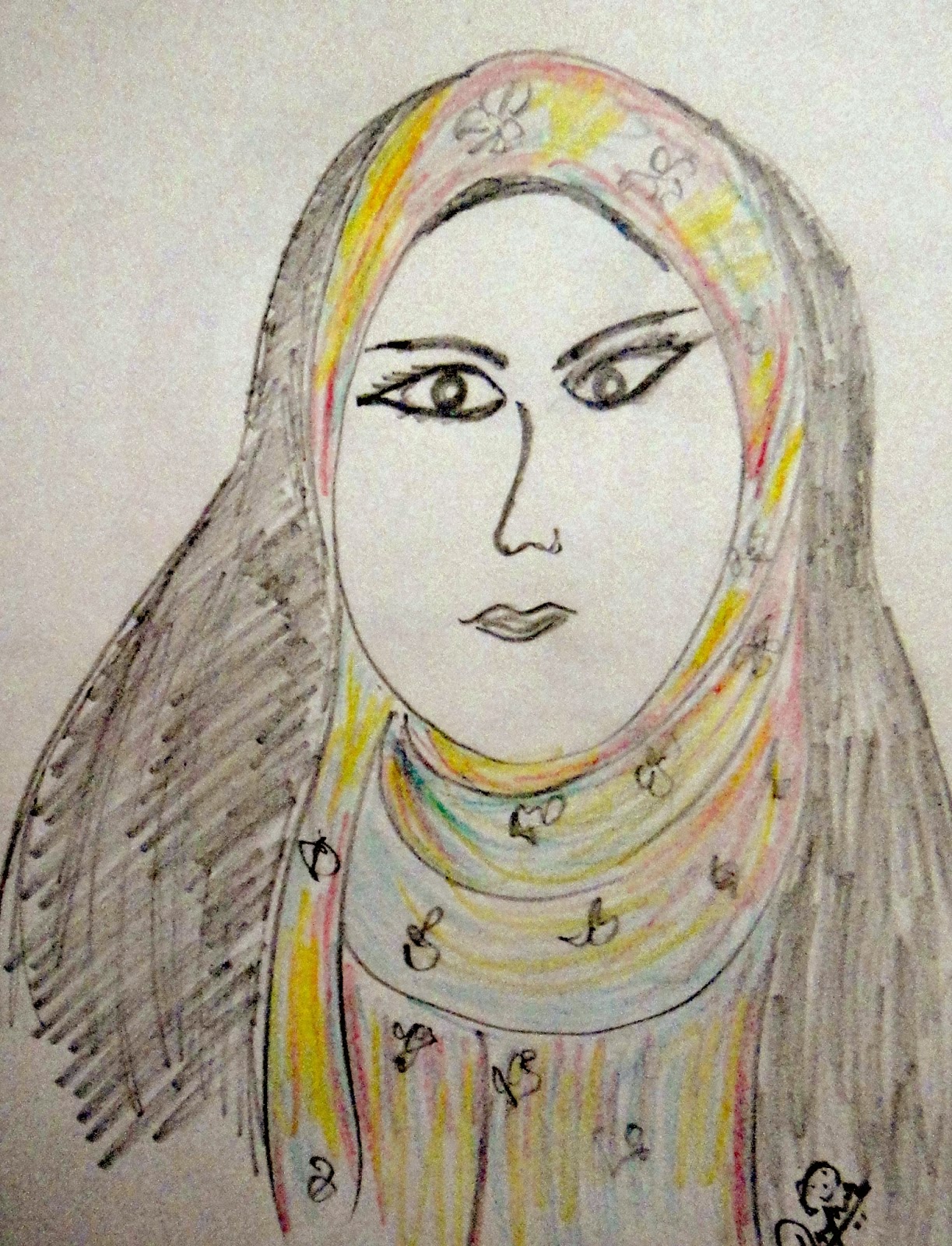
Below are the sketches of a few Omani dresses that I have observed; different combinations of Abaya (also known as Dishdasha), Hijab and Burqa worn by the Omani women depending on the tribes and region they belong to.

A woman in Sohari Burqa - Mask with only slits for the eyes
Abaya and head scarf all in black
Bedouin Burqa - Mask covering the nose and upper lips
Black Abaya and head scarf with golden embroidery
Bedouin Burqa - covering the forehead,
thin line covering nose and upper lips
Colorful Abaya in solid color or colorful prints

Why Black Abaya?
Women here are commonly seen attired in black abayas. Some women wear long black gloves to cover their hands too. It is said that women here till the 1960s and 70s wore simple but colorful clothing. Many Omanis here blame Iran and Saudi Arabia for the Black Abaya entering into Oman. Most of the girls start wearing the black abaya since the age of 13 or 14. Although their religion doesn't dictate that they should wear black, for some wearing a black abaya is classic and elegant style, for some it's a matter of reputation, for some it's out of fear of the society, while some wear it because they don't want to stand out and become a source of scandal.

Recently noticeable are black Lahafs with golden borders and colorful embroidered designs and black Abayas with golden linings or colored embroidered borders on the necklines and sleeves. Also, most of the women cover their head completely with not even a single strand of their hair being noticeable. But nowadays women are coming out of their shells slowly, especially in the cities, and once in a while we get to see the women with head scarves a little receded, highlighting the crown of their head, with centrally parted hair. Some of the women also have gold or silver jewelry adorning the head scarf. Black Abayas combined with colorful head scarves are in fashion in the city of Muscat. Also, I have noticed some Omani women dressed in Abayas - covered from top to bottom, but noticeable below the Abayas are a pair of tightly fitted denims and fashionable high heeled boots. After all, the times are changing, and with it the trousers are replacing the sarwals.
Black headscarf with golden border
Black Abaya with golden embroidery
Black or colorful Abaya
Gold jewelry adorning the head scarf
Black or colored Abaya
Colorful printed Lahaf 
Black or colorful Abayas, Receded Colorful Lahaf
 Hair of the crown with central parting visible
Modern Omani Woman as seen in the cities
An Omani Woman's attire is incomplete without accessories. Depending upon the tribe, they may wear gold or silver accessories. I have seen some women of the Bedouin tribe wearing lots of silver accessories: silver necklaces, earrings, and beautiful jewelry on the forehead too. For daily use, they wear a type of 'slip on' shoes called the 'Nahl'. The Omani women are also fond of heavy makeup on their faces. I have noticed many women with a bright colored eye-shadows matching with their dresses, but here I am not going to dwell into their cosmetic culture.

Decorum - A sneak peek into the culture of the Omanis

Out of the several years spent in the Gulf, I noticed one thing and that is the hospitality extended by the localites here. Talking just about Oman here, the foreigners are welcomed with open arms and straight from the heart. Rarely will you hear the foreigners or the expats bad mouthing the Omanis. The Sultanate expects us to follow its cultural norms. Though the country is conservative in its traditions, it welcomes modernization in its buildings and infrastructure. But the same cannot be said about its attitude towards women. As I have earlier stated the women here did not occupy an important role until 1970s, and slowly with the Sultan's effort women are now seen both in public and private sector. 

There are written instructions in most of the malls and public buildings about dressing appropriately. Women should wear loose clothing, with arms and shoulders covered. Skirts should cover the knees, and one must carry shawls. Dress codes are less crucial for men. Also innocuous hand gestures are punishable under Omani law if deemed offensive. Often, before an outing here, a lot of my time is spent, in planning what dress I should wear and depending upon the destination and the location, I arrive at a final decision. It is important to be culturally correct and dress appropriately.


Courtesy policy in a mall in Muscat

People here meet with an elaborate formality. A chain of greetings before coming to the point! For example : "Salam waleh qum. Walah qum salam. Kaifa Haaluk. Ana Bikhaiyr, Shukran. Sabah al Khayr. Sabah al noor. Masaa al khayr..,"and so on. Greetings are followed by a handshake (man to man), then inquiry about health, well-being of the family and children, and only after that you proceed with the matter of importance. If you talk about business right away, then they will assume that either you are rude or impatient or not interested in them personally. Also, offer or accept anything being offered with your right hand (same concept as us Indians). While sitting, keep your feet flat on the ground and not cross-legged. And yes, during Ramadan (the month of fasting), eating, drinking and smoking in public is completely banned. It is difficult for expats at times, for even the restaurants remain closed during the daytime and they open in the evening after the prayer time. So in the month of Ramadan, during the lunch hours, if I want to order a food parcel from a Restaurant, in case of an emergency, it is not possible.

Concluding

Compared to other Arab societies, Omani women have traditionally enjoyed higher profiles and active participation in the society. Within the family unit they make strong contributions towards making family decisions, regarding various rites. Omani Women are now seen actively participating in civil services, the defense sector and also appointed in senior government decision making positions. With their presence in top corporate positions in banks and MNCs and as Entrepreneurs, they are not only supporting their families but are also contributing to the economic development of the Sultanate.

Many women (in India, Oman and around the world), are unable to exercise their existing rights because of social pressure, lack of family support and lack of legal knowledge. Educated, trained and professional women contribute to the positive development of any society. With this belief, I hope that the new year 2015, brings education, enlightenment, empowerment and liberty for more women all over the world.

Pray for a better tomorrow for us women 
Pray for the world without fetters,
Pray that we tread without fear,
Pray there is no sadness in our eyes,
Pray each day brings only smiles, 
Pray that our dreams meet with success,
Pray for each step for a better tomorrow.


Sources referred:
www.bu.edu/wcp/Papers/Huma/HumaSing.htm
Language of Dress in the Middle East, by Bruce Ingham, Nancy Lindisfhame
www.centreforomanidress.com
www.everyculture.com
www.countryreports.org
www.reuters.com

14 Dec 2014

Roundabouts in Muscat - Freedom Circles


Do you ever go back and read news about your hometown? I do it quite often. A couple of months back I read that the State government of Gujarat created an SPV (Special Purpose Vehicle), to promote the city of Vadodara as the Cultural capital of Gujarat during the Vibrant Gujarat Global Investors Summit. This is the first time ever that a state government has ever created a SPV for promoting tourism. I was glad that my parents selected Vadodara for settling down after retirement.

For those of you who don't know, Vadodara is the third largest city in Gujarat (after Ahmedabad and Surat). Though it may not be the hottest or the hippest city in the state, the youngsters are lured to the city due to the presence of good schools and colleges, industries, restaurants, shopping malls and multiplexes, and more, all at an accessible distance. The presence of heritage buildings, temples, beautiful gardens and the pleasant weather, make it a comfortable city for the older generation, no matter how big or small is one's savings account. For us, being Probashi Bengalis (a Bengali living outside Bengal) with our roots in West Bengal, the city of Vadodara served our purpose: it was a peaceful locality, easy availability of basic necessities, hoards of like-minded Probashi Bengali friends, cultural diversity with amalgamation of people from all over the country, and our unending quest for art, music and cultural inclinations were quenched.

Apart from being an educational, industrial and cultural hub, Vadodara is also one of the safest city for women and you can count my vote on that. For years traveling within this city, be it at morning or the night, has never been an issue for me. I remember giving crisp instructions to the rickshaw-wala "Bird circle chalo aur aage se left lena...." (Take me to the Bird circle and then turn left) or "Genda Circle se seedhe lena..." (Go to the Rhino circle and then keep straight) or "Ellora circle chalna hai" and more and we women safely reached our destination. No need for Uber taxis!

Now why am I harping about the city of Vadodara and about a set of instructions to a rickshaw-wala? What connection does that have to do with my musings in Muscat?

Well, here's the connection between Vadodara and Muscat - Roundabouts. I admired the city of Vadodara for its roundabouts. And Muscat is another city with beautiful roundabouts. I am sure many of you use roundabouts as a mean to remember places and reach your destination without any confusions. So what's there to talk about traffic roundabouts? There are roundabouts all around the world. They are an essential element of traffic systems around the world. 


Al Wizarat Roundabout, Al Khuwair, Muscat
For those who are interested, here's an exact definition of roundabouts as per 'Manual on uniform traffic control devices' - A circular intersection with yield control of all entering traffic, channelized approaches and appropriate geometric curvature, such that travel speeds on the circulatory roadway are typically less than 50km/h. Contrary to our belief that roundabouts, traffic circles and rotaries all mean the same, in the US, the roundabouts and traffic circles are clearly defined to be separate entities. In a roundabout, the entering traffic must always yield to traffic in the circle while in a traffic circle the entering traffic is either controlled by stop signs or is not formally controlled.

Many research studies show that compared to the signals, the roundabouts are better aided to control traffic and are safer too. Below are highlights from some of these research (the figures may vary) which makes me vote for the roundabouts.
  • Roundabouts result in 90% reduction in fatal crashes
  • 75% reduction in injury crashes
  • 30-40% reduction in pedestrian crashes
  • Carry 30-50% more vehicles than similar sized signal intersections during rush hours because traffic is always on the move.
  • Maintenance costs are less than traffic signals since they cut the electricity expenses for stop-lights and there is no cost of equipment.
  • Encourage slower speeds and allow easier decision making
  • Improve pedestrian safety
The above research findings clearly indicate that roundabouts are a better street element than traffic signals. They should be adopted in all the cities for they are safer, greener and more aesthetically pleasing than crossroads or traffic lights. Roundabouts can be designed to accommodate appropriate demand volumes such that they are more efficient than a signal intersection. 

An interesting finding is that the amount of space a roundabout needs for its approach road is less than that required for signal or controlled intersections. The residual space provides room for wider sidewalks and landscaping. The centre of the roundabouts can be transformed into gardens, contain statues or public art and serve as an identity for a particular neighbourhood. A person associates an image of the neighbourhood or community through these roundabouts. It aids in enhancing the driver attentiveness, reduces automobile idling and efficiently stream traffic through an area. They are more cost effective and safer than intersections that require electricity. 

Also, roundabouts can aid in increased economic activity. Studies indicate that areas having roundabouts have prospering business especially those that rely on drive-by and impulse buying. Hence, gas stations, quick stopovers for grocery purchase, coffee shops, and restaurants usually thrive around these roundabouts. Roundabouts aid in calming the traffic, so driving at a slow speed, a person gets a better chance to view the Signage and the Buildings. Chance of finding a mode of transport (viz. taxi/cab or a bus waiting for customers), near  a roundabout is also higher than in other locations. 

Ask me about red lights at traffic signals. I hate them. From my personal commuting experience (to and fro from my home to my workplace), I can say that red lights are a total nuisance when you want to reach your workplace on time or when you want to reach home early. They delay your journey, make you impatient and are generally annoying. I remember seeing funny and annoying things that people do; not only the one on the driver's seat but also those on the passengers' seat. Here's a small list of the funny and annoying things I observed : Nose picking, makeup addicts reapplying makeup to their already made up faces, fiddling with the steering wheel, playing with the mirror, sliding windows to smoke, boringly watch at the vehicles flanked on each side, gulping down a drink or too, belching after hungrily gorging up a McDonald burger, taking photo of girls in the next car, rolling down the window and play the music loud for all to hear, gargling and mouth-washing, and here's the most annoying one - suddenly sliding down the windows for shooting out the betel nut chews. I can probably dedicate an entire blog on these annoying instances! 

While the traffic signals are annoyingly boring, the roundabouts have a story to tell. They transform the monotonous driving routine into a pleasurable experience. 

There are beautiful roundabouts in Oman, each one unique in its design and a piece of art. I termed these roundabouts as Freedom Circles - freedom from annoying, polluted and congested signal lights. The construction of roundabouts here blends modernity with heritage and history, and reflects the artistic bend of mind of the Omanis. Also, combined with these beautiful roundabouts, the excellent road network intertwined with green patches and flowerbeds, transform Oman's image from a desert land into that of a tropical region.

A road flanked with floral beds and lawns interspersed with palm trees, Muscat
Each roundabout here has a distinct relation to Oman's culture. I have seen incense burners, teapots, coffee urns, fishes, dhows, a treasure box, khanjars (daggers), and more as centre-pieces in these roundabouts. The teapots and the coffee urns are a reflection of Omani Hospitality. The Khanjar is the national symbol of the Sultanate of Oman, is depicted in the national flag, in the currencies, and can be seen in many important public buildings. The dhows symbolize the significance of this country as a seafaring nation. Every roundabout here is amazingly beautiful. They are designed considering every small detail and are meticulously maintained by the municipality. Circular borders separate these roundabouts from the tarmac road, then there is well laid gently sloping grass and flower beds, and finally the centre piece which adorns the roundabout. I take a chance here to highlight a few of the roundabouts in Muscat.

The Burj Al Sahwa Clock Tower, Seeb, Muscat
This clock tower roundabout greeted us when we entered Muscat from the International Airport. 'Burj' in Arabic means Tower while 'Sahwa' means awakening. This 50.0m tall tower was built in 1985 to commemorate Oman's 25 years of Renaissance hence the name 'Sahwa' tower. It is made up of four columns with archways on the top. A large clock adorns each side of the tower. The clock has ornate black hands on a white face with Arabic numerals. Surrounded by large panels that present images of Oman's rich history, it is useful as a speedy introduction to passengers arriving in the country and as a final farewell to those departing too. 
The Al Sahwa roundabout, Seeb, Muscat
( a pencil sketch)
The Fish Roundabout in Muttrah, Muscat
The Al-Samak or Fish roundabout is a beautiful roundabout with the central piece as a pair of fishes. It is surrounded by two layers - the inner circle is a circle of fountains while the outer one is a bed of flowers. Another circle of a concrete layer separates it from the tarmac road. As I had mentioned in one of my earlier post, fishing is an important economic activity for the Omanis and a fish symbolizes fertility and prosperity.
The Fish Roundabout - Al Samak Roundabout, Muscat
(a pencil sketch)

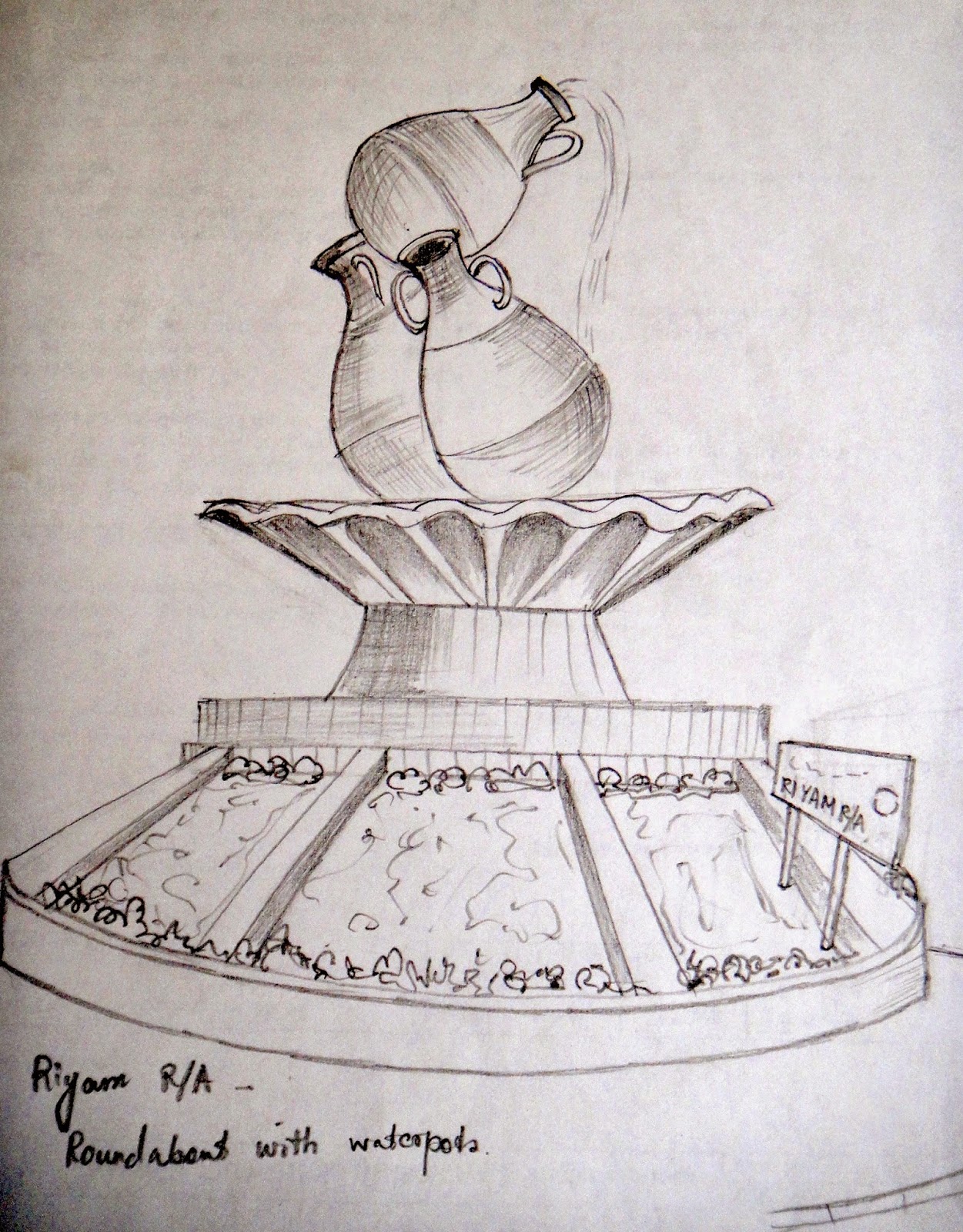
Riyam Roundabout, near Riyam Park, Muscat
This roundabout, with decorative gold waterpots as the central piece, has water flowing out from each of the pots. It has an outer circle embedded with flower beds and then another circular ring in concrete to separate it from the tarmac road. The pitchers, in the centre piece, is another important link to Oman's culture. Pottery making is an ancient industry for Oman. The pots known as 'jihal' are used for keeping water, the 'khuroos' is used for keeping dates and water, smaller ones are used for keeping honey, and 'brams' are used as cooking utensils.
Riyam roundabout near Riyam park, Muscat
(a pencil sketch)
Roundabouts render a character to the city and its precincts. People often associate a city with these landmarks. Unfortunately, increase in population growth and increase in vehicle ownership has resulted into increased pressure on the traffic control systems and this has made the Oman municipality rethink over its existing roundabout spaces. The trend is now to convert these roundabouts into signalized intersection. Two beautiful roundabouts in Oman were razed completely viz. Sohar Globe roundabout in Sohar and the Wadi Kabir Bakhoor roundabout in Muscat, to make way for fly-overs, to ease the traffic flow.
No more - Globe roundabout, Sohar, Oman
No more - Bakhoor roundabout, Wadi Kabir, Muscat
The Oman's Municipality justified that the main reason to remove these landmark roundabouts was to avoid traffic jams. At the same time, it is installing roundabouts at other locations and new ones can be seen sprouting from time to time.

Trivia on Roundabouts:
  • Widespread use of modern roundabouts began in UK in the 1960s while in the US they emerged in 1990s.
  • France has the largest number of roundabouts in the world - more than 30,000.
  • World's largest roundabout: Queen's Park Savannah in Trinidad and Tobago  - This park in Port of Spain is the largest open space there and is the world's largest roundabout. Also known as the Savannah, it occupies 1.1 sq km area and has a diameter of about 3.5 km.
  • Putrajaya in Malaysia also claims to have the largest roundabout in the world with a diameter of 3.5 km.
  • The largest roundabout in India is Swaraj roundabout in Thrissur, Kerala. This roundabout occupies an area of  64 acres and in the centre is a popular Shiva temple. All the roads of Thrissur connect to this roundabout.


Sources referred:
www.uc.edu
www.wsdot.wa.gov
www.bikewalk.twincities.org
Wikipedia
gulfnews.com
tourismoman.com
roundaboutresources.org